ALL THE SMALL THINGS: FINDING SPEED AND PERFORMANCE IN THE DETAILS
In the modern America’s Cup, speed is rarely the result of a single breakthrough. It is built through thousands of decisions, continuous refinement and close collaboration between the entire team: the people designing, engineering, building, and sailing the boat.
With the Class Rules and Technical Regulations defining many of the AC75’s major parameters, the challenge for the Louis Vuitton 38th America’s Cup is not necessarily to reinvent the boat, but to find the many small opportunities to make it better. The foils, rudder, sails, and control systems remain key areas for development and the gains can be remarkably small–but crucial for a successful campaign.
“I don't think there is any idea that's too small,” says Dave Olsen, Structural Engineer at Emirates Team New Zealand. “We collect all of those ideas and sit down as a group and work out which ones we think actually have some potential.”
That mindset underpins the design process. Ideas come from across the team, whether from the designers and engineers exploring technical possibilities, sailors sailing the boat on the water or the shore crew working in the shed. The challenge is to identify which ideas have the potential to make a meaningful difference.
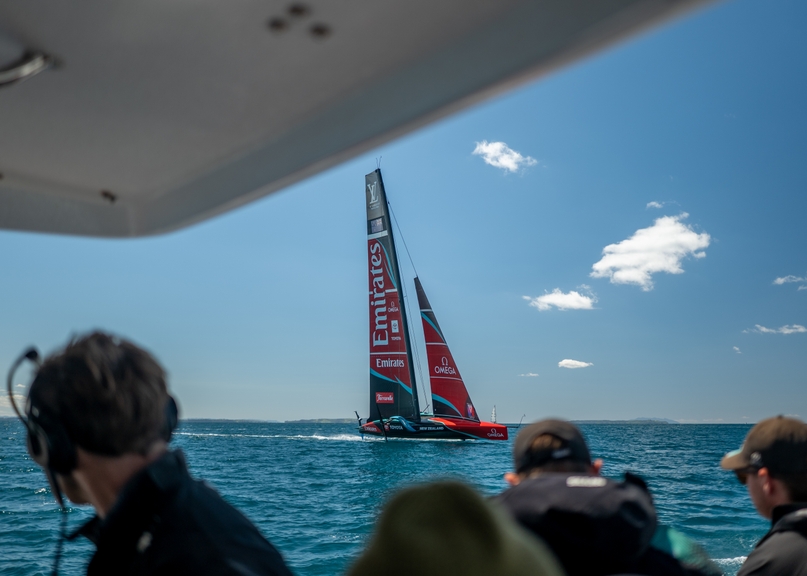
For foil and sail shapes, much of this work is driven by mathematical optimisation and computer simulation. The team can explore enormous numbers of possible configurations, with computing power allowing potential designs to be iterated around the clock. What ultimately makes it onto the boat is only a fraction of that work: the result of countless calculations, comparisons and decisions made long before a component reaches the water. “What you see in our race boat is the one per cent, or the point one per cent,” says Dan Bernasconi, Head of Design.
Identifying the right solution is not always straightforward. With the many variables and parameters present in high-performance sailing, it is getting increasingly difficult to evaluate which changes have what influence. Simulations provide an important reference in this decision-making process.
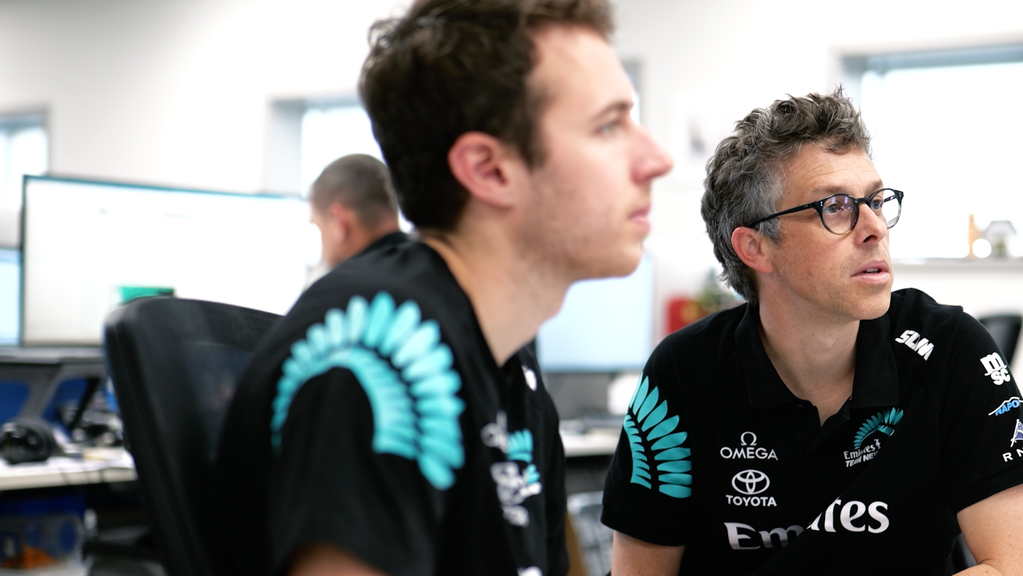
“The main word that we use a lot is 'trade-offs',” says Bobby Kleinschmit, Principal Naval Architect, highlighting as well the importance of experience in this process, and this is where the relationship between the design team and sailors becomes particularly important. The designers and engineers develop ideas and make predictions; the sailors test them in real conditions and return with feedback that helps the team refine its understanding.
“We try to keep a really tight feedback loop with the sailors, because that's the most efficient way to make progress,” says Dave Olsen. In many ways, the process mirrors other high-performance sports such as Formula 1, where specialised teams work across design, engineering, simulation and testing to find marginal gains, balancing performance, technical constraints and feedback from drivers, or as in our case, the sailors.
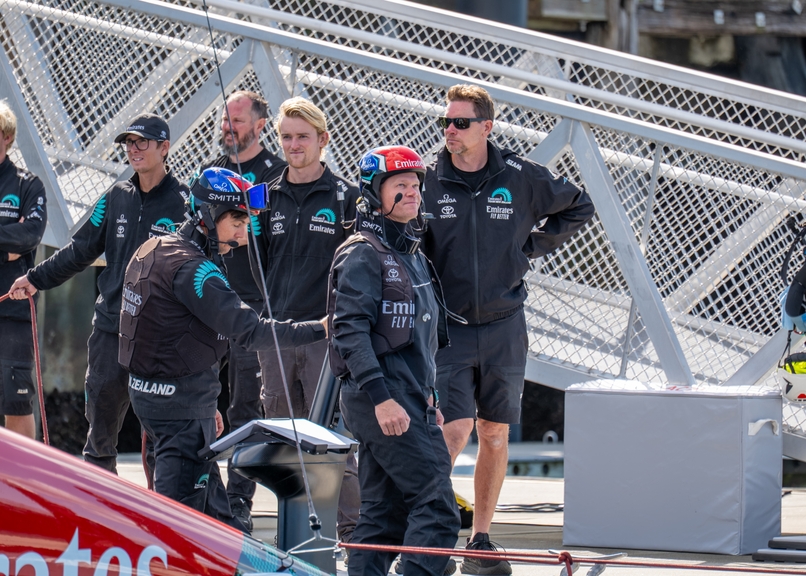
Ultimately, finding speed is a collective effort. It requires the curiosity to explore new ideas, the discipline to narrow them down, the tools to test them and the experience to understand what the results mean in practice.
Performance emerges from the accumulation of all the small improvements.
WATCH THE LATEST EPISODE OF FINDING FAST HERE
RELATED ARTICLES
AC75 TESTING RESUMES WITH NEW UPGRADES FOR TAIHORO /// PRELIMINARY REGATTA NAPLES UNDERWAY WITH OFFICIAL PRESS CONFERENCE /// NAPLES PRELIMINARY REGATTA LINE-UP /// 2027: THE LOUIS VUITTON 38TH AMERICA'S CUP